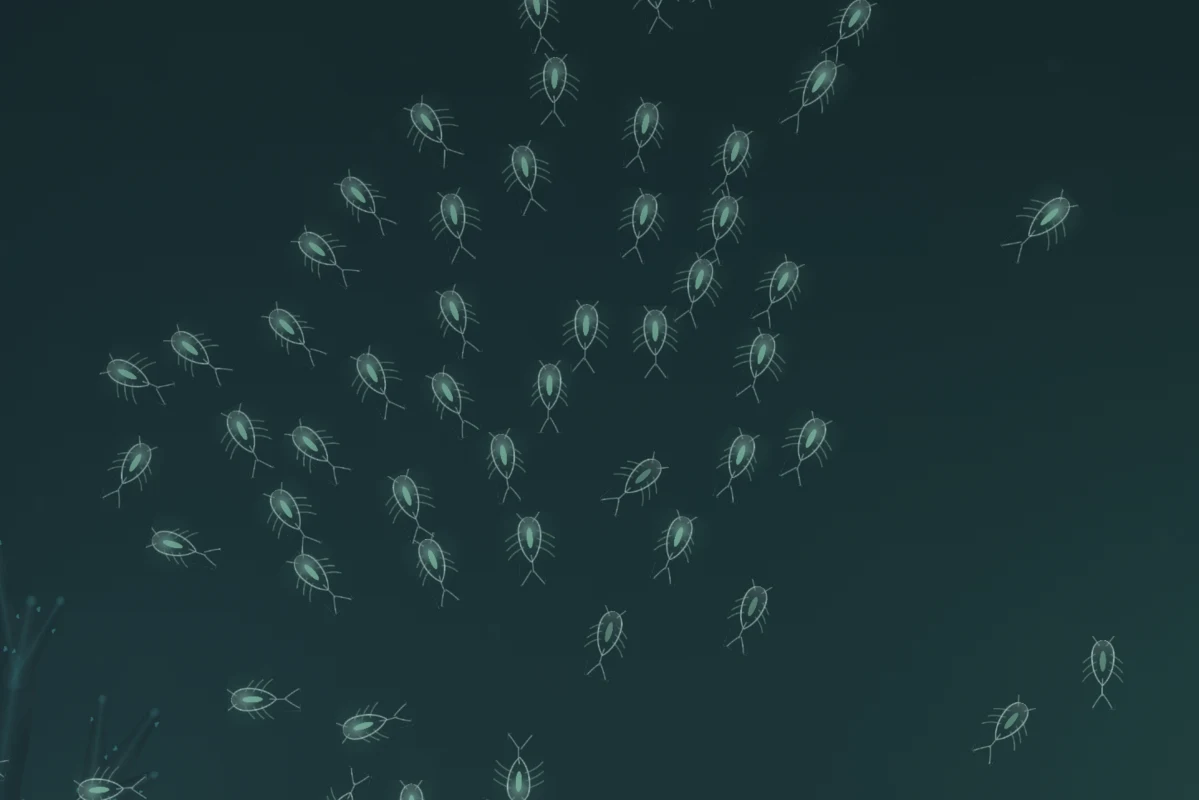
Scent-led swarm feeder
Glass Skipper
Small, quick and blind. Glass Skippers follow animal chemistry, take small bites, and become formidable when many arrive together.At a glance
How it finds food
Animal chemistry draws a hungry Glass Skipper into moving water. Fresh wound material gives it a stronger course, while its antennae resolve nearby bodies and neighbours.
How it survives
One Glass Skipper has little leverage. A dense, feeding group is different: repeated bites can deplete a much larger body, while a foodless crowd eventually disperses.
How it breeds
A ready female releases a transported reproductive cue. After pairing, she lays drifting eggs where animal-food chemistry gives the next generation a useful start.
Simulation values
These values are read from the live species tuning table during the build.
Body & movement
body mass50 g
How big a grown Skipper is. Its reach, its gut, what it releases, and what a clutch costs all scale from this.
Adjustable range 10 g–200 gcruise0.32 m/s
Full sustained swimming speed during a supported course. Uneventful drift and anonymous wake checks use bounded fractions of it.
Adjustable range 0.02 m/s–0.9 m/sturn rate1.5 rad/s
How fast a body can swing its heading, in radians per second. Low turns read as an animal; high reads as a cursor.
Adjustable range 0.2 rad/s–6.0 rad/sdrift carry×0.68
How much of the water's motion carries a body along. This is displacement the water does to it, never effort it spent.
Adjustable range ×0.00–×1.40flow affinity0.00
Which way a body chooses to face relative to the water. Negative holds station facing into it, positive rides it downstream, zero leaves it to its own meander. Being carried is separate and always happens.
Adjustable range -1.00–1.00jump speed1.65 m/s
Speed of an approach or escape burst. Far above anything the current does, so either reads as a decisive stroke.
Adjustable range 0.2 m/s–4 m/sjump time0.17 sec
How long one burst lasts. A maximal escape needs four times this to recover; a controlled approach dart needs half this.
Adjustable range 0.05 sec–0.6 secFeeding & survival
bite recovery2.4 sec
Seconds between small contact bites. Lower makes a body wound and consume food faster.
Adjustable range 0.2 sec–8 secmaintenance3.2e-3/s
Stored material spent per unit of body material per second simply staying alive.
Adjustable range 5.0e-4/s–2.0e-2/sresilience2.5 min
How long a body holds on with an empty gut before it begins to fail.
Adjustable range 20 sec–6.67 minforage×1.4
How strongly appetite and animal chemistry support feeding against Tarantor risk. Water motion cannot cancel an accepted food course.
Adjustable range ×0.0–×3.0Senses & search
response threshold0.18
Immediate evidence needed before a pressure course or escape. A wake causes a swimming approach; Tarantor chemistry causes a burst away. Lower is more reactive.
Adjustable range 0.02–1.00food scent2.0e-3
Animal or wound chemistry that makes a place worth searching and laying near.
Adjustable range 1.0e-5–0.1000Reproduction & lifespan
maturity2 min
How long a body must live before it can breed. Also how long it spends growing into its full size and forked tail.
Adjustable range 10 sec–10 minbreeding reserve70%
Share of a full gut a body must carry before it will breed. Only well-fed adults take part, and a fuller female commits a larger clutch.
Adjustable range 20%–100%cue life40 sec
How long a released cue lingers in the water. Longer trails reach further downstream and blur into each other.
Adjustable range 2 sec–3 mincue threshold2.0e-5
Faintest trail a male will turn toward. Lower sends him chasing water that barely smells of anything.
Adjustable range 1.0e-6–5.0e-4trait spread30%
How far an inherited trait may range either side of the species norm. The whole allowance: at 0.3 nothing can be more than fifteen percent off standard.
Adjustable range 0%–60%lifetime15 min
How long a body lives before age alone begins to fail it, however well fed it is. Without this a Skipper that reaches a plume never ages out, and the population only ever grows.
Adjustable range 1 min–1 hr