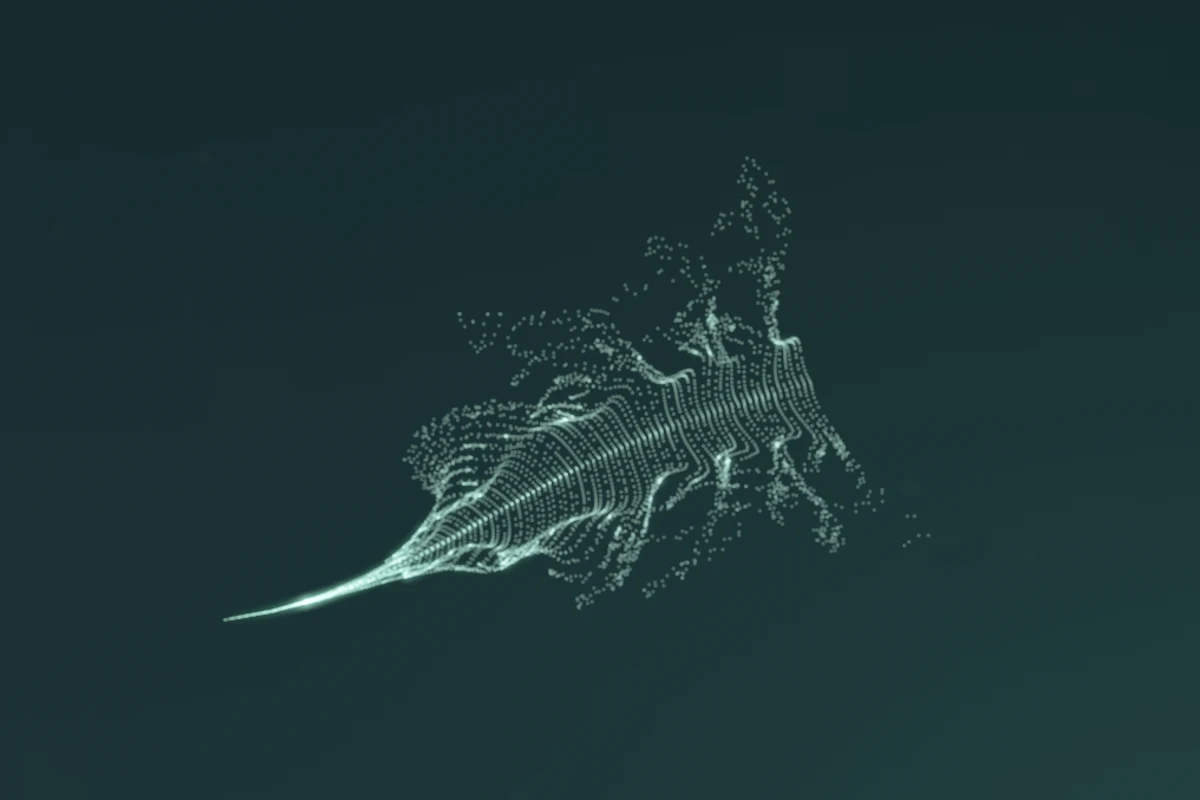
Learning large-bodied forager
Tarantor
The largest animal in Simceladus. A Tarantor combines sharp senses, a long feeding whip, and memories formed through imperfect encounters.At a glance
How it finds food
A Tarantor weighs sight, chemistry, pressure, touch and memory. It closes on promising evidence, casts its whip, and brings a suitable body to its mouth.
What it remembers
Encounters become bounded lessons. Productive places, familiar bodies, costly crowds and useful forms can change what receives attention next time.
The cost of being large
A large body carries a useful reserve, but every movement spends material. A long chase that ends badly makes the next decision more urgent.
Simulation values
These values are read from the live species tuning table during the build.
Body & movement
body length1.5 m
Nose to trailing filaments, in centimetres. A Tarantor is an order larger than a Glass Skipper and reads as the biggest thing in the water.
Adjustable range 30 cm–4 mcruise0.95 m/s
How fast a reference-length adult swims under its own power. Actual world speed scales with body length and inherited speed, keeping juveniles on the same anatomical gait instead of making them tiny projectiles.
Adjustable range 0.1 m/s–3 m/schase×1.45
Cruise multiplied by this while closing on forage. Its turn rate does not rise with it, so committing to a chase widens the arc it can hold — a body that commits harder is a body that is easier to slip.
Adjustable range ×1.00–×2.50turn rate0.9 rad/s
How fast it can swing its heading, in radians per second. Low on purpose: a large body turns in long arcs, and that is most of what makes it read as heavy.
Adjustable range 0.1 rad/s–4.0 rad/sdrift carry×0.35
How much of the water's motion carries it along. Lower than a Skipper's: a body this size is pushed around far less by the same current.
Adjustable range ×0.00–×1.40Feeding & survival
maintenance1.2e-3/s
Stored material spent per unit of body material per second simply staying alive. Swimming costs more on top of it, so a body that chases hard eats sooner.
Adjustable range 2.0e-4/s–1.0e-2/sresilience4 min
How long it holds on with nothing stored before it fails. Longer than a Glass Skipper's, because a large body carries its own margin.
Adjustable range 30 sec–10 minattention×3.0
How much propulsion the attended episode requests. Body pressure prices the episode before this motor scale is applied.
Adjustable range ×0.0–×4.0Senses & search
sense range4.2 m
How far ahead it can feel rock coming. Short range means late, sharper avoidance; long range means it commits to a line early.
Adjustable range 60 cm–9 mclearance×1.7
How much it cares about not meeting rock. Every shortened whisker contributes its squared closure, so a side wall remains real after the body becomes parallel while distant terrain costs almost nothing.
Adjustable range ×0.0–×4.0explore×1.0
How strongly it holds its own slow wandering heading while no episode owns movement.
Adjustable range ×0.0–×2.0search trace×0.7
How firmly a rising trace of its own surface chemistry pushes it toward less familiar water. Food, sight, and touch make this yield rather than turning feeding grounds into forbidden places.
Adjustable range ×0.0–×2.5Reproduction & lifespan
nursery warmth6.0e-5
Ambient-relative heat at which a near-term mother considers the water a suitable nursery. Warmth remains a preference, never a delivery gate.
Adjustable range 0.0000–5.0e-4nursery ceiling2.4e-4
Upper edge of the preferred nursery band. Hotter water sends a mother back down the local gradient instead of into the Vent mouth.
Adjustable range 0.0000–0.0010trait spread24%
How far inherited frame, speed, and power can vary around the species norm. Pigment and fringe remain visibly individual at zero.
Adjustable range 0%–50%lifetime30 min
How long age alone allows a body to continue. Reaching it begins an irreversible decline even when the body is fully fed.
Adjustable range 10 min–4 hr